
Stop Over-Complicating Directions for your Toddlers
If you’ve ever said to your toddler:
“Go get your shoes from the living room and bring them back here so we can go outside,”
and they either ran to the door to go outside OR just stared at you confused… this post is for you.
Parents often complain that their 2 year olds are too defiant and won’t listen to them, but what’s more than likely happening is their brain simply isn’t ready to process that much language that quickly. (Am I saying terrible twos aren’t true? Heck no, I have a 2 year old, they’re feisty! I’m just saying that sometimes we expect too much of them.
What’s happening in a 2-year-old’s brain?
At age two, children are still developing the systems in their brain that allow them to:
Process spoken language
Hold information in memory
Pay attention long enough to act on what they hear
Even though your child may understand many words, their working memory (the part of the brain that holds information long enough to use it) is still very limited. That means they can’t hold long sentences, multiple ideas, or lots of details in their mind at once.
Most 2-year-olds are able to:
Understand and use familiar words
Follow simple one-step directions
Respond best when language is short, concrete, and clear
Multi-step directions, long sentences, and extra details usually don’t become reliable until closer to ages three and four.
Too many words make directions harder
When we give a long direction, a toddler has to:
Listen to all the words
Figure out which part matters
Remember what to do and in what order
Ignore everything that isn’t important
That’s a lot for a tiny brain.
So when a parent says,
“Can you go to your room, find your shoes that are under the table, and bring them back so we can go outside?”
A 2-year-old may only catch pieces like:
“Go… room… shoes… outside…”
They aren’t being stubborn, they just don’t have the brain capacity yet to sort through all that language and sequence your directions.
Simple directions actually support language development
Using fewer words doesn’t mean you’re lowering expectations or “dumbing things down.” It means you’re matching your language to what your child’s brain can handle right now.
When directions are simple, children:
Succeed more often
Feel less frustrated
Learn new words through repetition
Build confidence in understanding language
And confidence is what allows language to grow.
How to simplify:
Here are a few simple ways to make your directions more toddler-friendly.
1. Put the action first
Toddlers process verbs better when they hear them early.
Instead of:
“Before we go outside, I need you to put your shoes on.”
Try:
“Put your shoes on.” or even “shoes on!”
2. Give one step at a time
Break multi-step directions into smaller pieces.
Instead of:
“Pick up the toys and put them in the basket.”
Try:
“Pick up toys.”
Then once that’s done:
“Put toys in the basket.”
A step further for this one: “toys go IN the basket”
3. Remove extra details
If a detail isn’t necessary, leave it out.
Instead of:
“Put the little blue car on the shelf over there gently.”
Try:
“Put the car on the shelf.” or “car on shelf!”
*A note on manners: I know it’s important to teach manners to young kiddos, but sometimes manner words can make directions clunky. Instead of always “please put your shoes on, thank you!” try to stick to the core words: shoes on! especially for younger kiddos.
4. Use gestures and pointing
Pairing words with visuals reduces the language load and helps toddlers understand faster.
Point to the shoes while saying “Put shoes on.”
Point to the chair while saying “Sit down.”
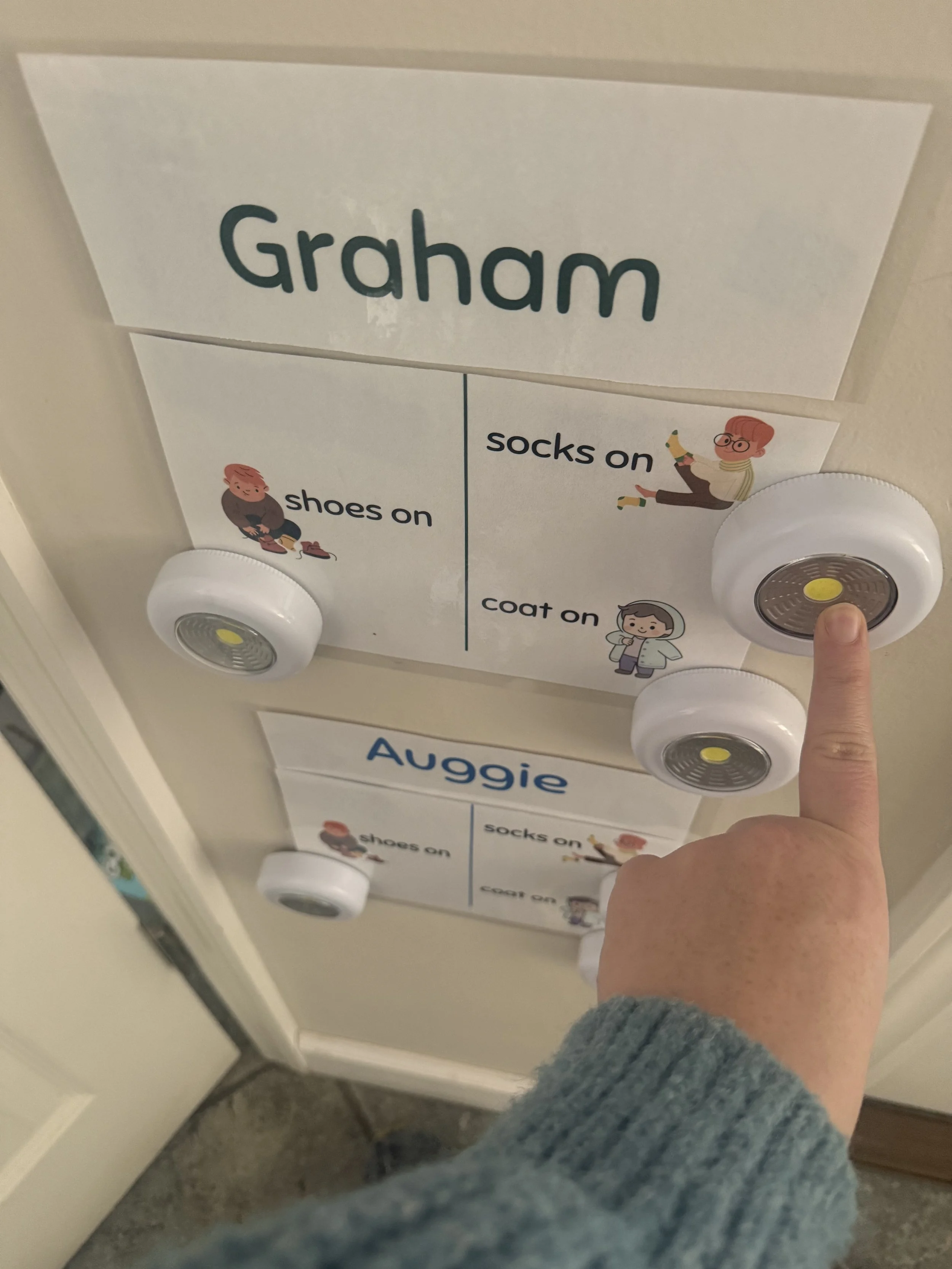
Using Visual Schedules in our home
One step beyond gestures is adding in visuals such as a visual schedule or picture cue cards. This has been really helpful in our home, not just for understanding directions but for aiding in faster transitions and getting out the door quicker each morning.
We created this 3 step schedule for leaving the house each morning: socks on, shoes on, coat on. I made the visuals on Canva, but you could easily create in a Word Document or Google docs as well! Each step has a little push light (click here for an affiliate link for the lights I use), a simple visual picture of the activity and the written words (for my older son who is beginning to read). This helps break down each part of our morning directions into one step at a time for my 2 year old.
You could use this for a bedtime routine or any tough transition at your home!
The bottom line
If your 2-year-old struggles to follow directions, it doesn’t mean they’re stubborn or behind. It usually means the language being used is more complex than their brain can process right now.
Fewer words lead to:
Better understanding
Better cooperation
Less frustration
Stronger language growth
As they get older, you can add in steps and extra words to make your directions more complex. In the meantime, keep it simple and watch the listening soar!
